
Knox County Open Records Coverage
Knox County divides record custody by subject. The Register of Deeds keeps land instruments, the Property Assessor maintains parcel assessments, and separate court clerks hold distinct case files. State offices control other records, including professional licenses and recent vital certificates. An online name result is often only an index entry. The underlying image, certified copy, or complete file may require an order from the named custodian.
| Record series | Keeper | Web route and coverage | Access channel |
|---|---|---|---|
| Deeds, trusts, releases, liens, plats | Knox County Register of Deeds | ROD and KGIS; office files reach the late 1700s, while one universal web start date is not stated | Online research, counter, mailed request; certified copies $1 per page |
| Owners, parcels, values, sales | Property Assessor | Property Lookup and KGIS; current data plus portal history | Free web tools or office inspection |
| Criminal and traffic matters | Criminal Court Clerk | Daily docket by date, name, or division; local search service reaches the 1980s | Portal, counter, file request, or $15 local search |
| Civil, divorce, probate, and wills | Circuit, Fourth Circuit, Chancery, or Probate clerk | Coverage differs by court; historic indexes also exist | Calendar or court page, counter inspection, copies by request |
| Birth and death certificates | Knox Health and Tennessee Vital Records | No open recent-certificate index; births transfer after 100 years and deaths after 50 | Eligible copy order; older records through TSLA |
| Jail, state felony, registry, licenses | Sheriff, TDOC, TBI, or state licensing boards | Separate current official lookup systems | Free portal, then the responsible agency for source files |
Open status is not universal. DD-214 military discharges recorded at the Register remain confidential. Juvenile matters, sealed or expunged cases, adoption files, protected identifiers, and recent vital certificates have separate limits. A portal miss may also reflect spelling, date coverage, an unlisted owner, or a file kept by another clerk. It does not prove that no record exists.
Knox County Public Records Law
The Tennessee Public Records Act, Tenn. Code Ann. §§ 10-7-501 through 10-7-515, gives Tennessee citizens access to existing state, county, and city records unless another law closes them. An agency may ask for proof of Tennessee citizenship. The Act does not force a custodian to create a report, perform research, or answer a question that is not contained in an existing record.
Inspection of open material during regular business hours is generally free. Copies may involve reasonable duplication and labor costs under the office’s policy. If a record cannot be produced promptly, the agency must act within seven business days by providing it, denying access in writing with the legal basis, or giving a written estimate of the time needed. That period is a response rule, not a fixed completion deadline for every large request.
Can anyone worldwide demand county files under the TPRA? No. Tennessee’s law is a citizen-access statute. A portal may still be open to broad use, but statutory inspection rights and identification steps may turn on Tennessee citizenship.
Knox County Deed Records Access
The Knox County Register of Deeds records warranty and quitclaim deeds, deeds of trust, releases, liens, powers of attorney, bonds, and plats. Its earliest hand-transcribed holdings reach the late 1700s. Most recorded material is public, but military discharges are not. A typical deed can be located with an owner name, legal description, and approximate recording date. Exact online coverage varies, so older or missing entries should go to the records desk. The official deed-copy request supports a mailed-copy route when KGIS research identifies the parcel but not the needed image. Copies are also available at the counter or by mail. Certified pages cost $1 each. The live form did not expose a dependable required marker for every input, so provide all known details without assuming that each box is mandatory.
| Portal field | Control | Expected use | Format note |
|---|---|---|---|
| Property owner/name | Text | Identify the indexed owner | Try spelling and name variants |
| Property address | Text | Identify the land through KGIS | Use the parcel route if address wording differs |
| Requester/contact information | Text, email, phone | Response and payment contact | Supply a reliable return channel |
| Request details/comments | Textarea | Narrow the requested deed | Add legal description, date, book, or instrument number when known |
| Submit | Button | Send the request | Copy charges still apply |
Staff assign an instrument number, scan and index the document, verify the entry, and return the original. A deed image may show grantor and grantee roles, value, legal description, derivation reference, preparer, and taxpayer address. Grantor means the party transferring an interest; grantee means the party receiving it. Those roles matter when two people share a name.
Note: The Register warns that liens may also sit with courts or the Secretary of State, so one deed-office search is not conclusive.
Knox County Property Records Systems
The Property Assessor lookup, KGIS map, and Trustee records serve different functions. The assessor connects a parcel to ownership, values, improvements, and sales. KGIS adds parcel lines, address points, aerial images, and district layers. The Trustee handles taxes and tax-sale material. A tax mailing address identifies where a bill goes; it does not establish where the owner lives.
KGIS accepts an address, parcel ID, owner name, or place. Its details can show an owner, parcel identifier, mailing and location addresses, acreage, deed data, subdivision, city ward or county district, and historical aerials. “Location Address” can differ from “Site Address,” especially on a parcel with several buildings. Likewise, recorded acreage comes from the deed while calculated acreage comes from mapped description work.
Use the map’s Ward and District fields to resolve jurisdiction. A Knoxville mailing address may lie outside city limits. That choice determines whether Knoxville or a Knox County office keeps a permit or code file. KGIS boundaries remain general reference lines, not a land survey, and the assessor offers a process to request unlisted ownership.
Knox County Court Records Search
No single clerk holds every Knox County case. Criminal Court and General Sessions criminal matters go to the Criminal Court Clerk. Circuit handles circuit civil and Civil Sessions files, while Fourth Circuit receives many domestic matters. Chancery covers equity and some domestic cases. Probate holds estates, wills, and fiduciary proceedings. Juvenile records are generally private, and federal cases use PACER rather than a county portal.
The Criminal Court daily-docket search is a calendar finder for Criminal, Traffic, and County Ordinance courts. Choose a date range, then use a name or division. No official start date is published for the searchable docket. A match can supply a setting date, division, and case or citation number, which should then be used to request the court file.
| Search label | Input type | Required | Options or rule |
|---|---|---|---|
| First Name | Text | Conditional | Use with last name and date range |
| Last Name | Text | Conditional | Use with first name and date range |
| Division Name | Dropdown | Conditional | All Divisions; DIVISION 1C; DIVISION 1; DIVISION 2C; DIVISION 2; DIVISION 3C; DIVISION 3; BONDED ARRAIGNMENT; DUI; FELONY; MISDEMEANOR; TRAFFIC AND COUNTY ORDINANCE |
| Date From | Date | Yes | Beginning docket date |
| Date To | Date | Yes | Ending docket date |
| Search Dockets | Button | No | Submits the search |
Tennessee Supreme Court Rule 34 presumes access to court case, administrative, and judicial records unless a statute, rule, or order protects them. A calendar listing is not a finding of guilt or a final disposition. For the actual result, inspect the docket sheet and identified filings through the proper clerk. Chancery and Probate requests work best with a party or decedent name, case type, filing year, and case number.
Knox County Vital Records Limits
Recent certificates do not become open records merely because someone files a TPRA request. The Knox County Health Department issues Tennessee birth and death certificates through a local channel. Tennessee Vital Records handles birth, death, marriage, and divorce certificates statewide. The County Clerk keeps a marriage license and return, while the court that granted a divorce keeps its case file and decree.
Under Tenn. Code Ann. §§ 68-3-205 and 68-3-206, the state retains births for the most recent 100 years and death, marriage, and divorce records for the most recent 50 years. Older birth and death records move to the Tennessee State Library and Archives. A recent certified copy requires the right relationship or authority, valid identification, a signed application, and a $15 nonrefundable search fee. Cause-of-death detail has narrower access.
When a certificate is closed to the requester, lawful historical routes include county marriage books, probate files, cemetery evidence, newspapers, and the Knoxville obituary indexes. Such sources may prove useful facts, but they are not certified substitutes. Older divorce material remains with the issuing court or archival custodian.
Knox County Records Office Map
Several key custodians work in the City County Building, yet they remain separate offices. Contact the unit that created or maintains the series. Most listed counters operate Monday through Friday, 8:00 a.m. to 4:30 p.m. Court calendars and copy rules still vary by clerk.
Knox County Register of Deeds
400 Main Street, Suite 225
Knoxville, TN 37902
865-215-2330
Records: 865-215-2329
County Clerk marriage services, Chancery and Probate files, Sheriff reports, Knoxville city records, and state-held files each have their own path. For Sheriff incident reports, email submission is free; counter copies cost $0.15 per page and require photo identification. The research notes a three-working-day allowance and recommends providing a case number or the names, time, place, event type, and daytime phone.
Knox County Custody Records Lookups
Custody and regulatory records are split across agencies. The Knox County Sheriff inmate population is a changing local jail snapshot. TDOC’s Felony Offender Information Lookup covers people in Tennessee felony custody or supervision. The TBI registry serves a distinct public-safety purpose. Charges remain allegations until a court resolves them, and a local jail result may change after release or transfer.
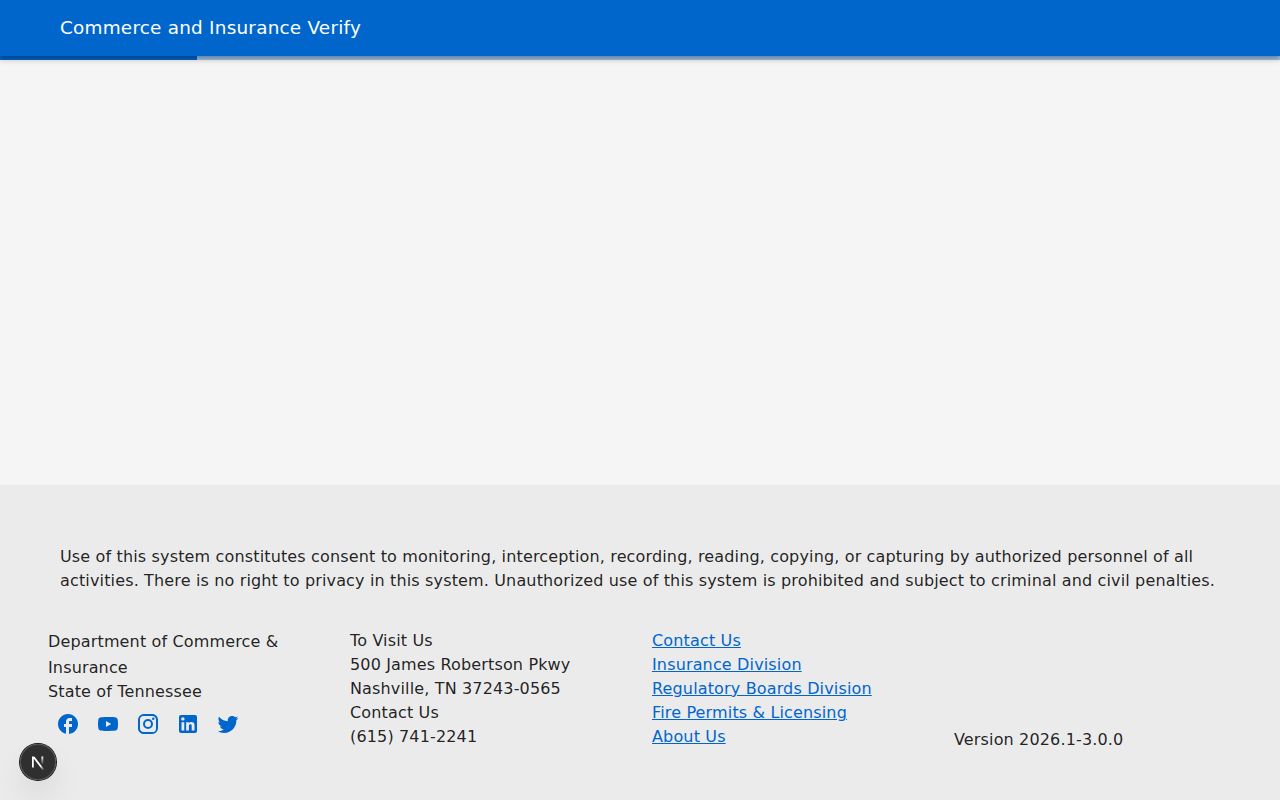
Professional credentials are searched through the state’s Verify.TN.gov license portal. Its results vary by profession and board, so confirm status, dates, and any linked discipline at the source board. The official search screen below represents the statewide route used for Knox County license verification.
A credential result identifies a regulated role, not a home address or proof of a person’s current Knox County residence. When a portal lacks an older action or source document, request it from the board that issued the license.
Lawful use. Use Knox County records for lawful personal research and civic safety. Never use an address, custody entry, or registry result to stalk, threaten, harass, or intimidate anyone.
Knox County Records Portal Myths
Online does not mean complete. A daily docket is not a full court index. KGIS parcel lines are not a survey. A deed index does not certify clear title. Even a well-run portal may omit an older volume, a sealed case, a protected identifier, or an ownership name suppressed through the assessor’s process.
Fallbacks depend on the series. Ask the Register whether an older book is indexed or imaged. Take a docket number to the correct clerk. Request non-current permanent county files through Knox County Archives. For city permits and code records, use Knoxville’s specialist custodian route; its work-record portal caps address results at 200, newest first, so a date or record-number range can expose older entries.
Note: A no-match should prompt a spelling, role, date, and custodian check before any conclusion about the person or record.
Knox County Record Alerts
The Register’s free Fraud Notification System emails an alert when a newly recorded document matches an enrolled name. Register each useful name form because matching is name based. An email signals that an instrument was filed. It does not prove fraud, verify identity, or guarantee title.
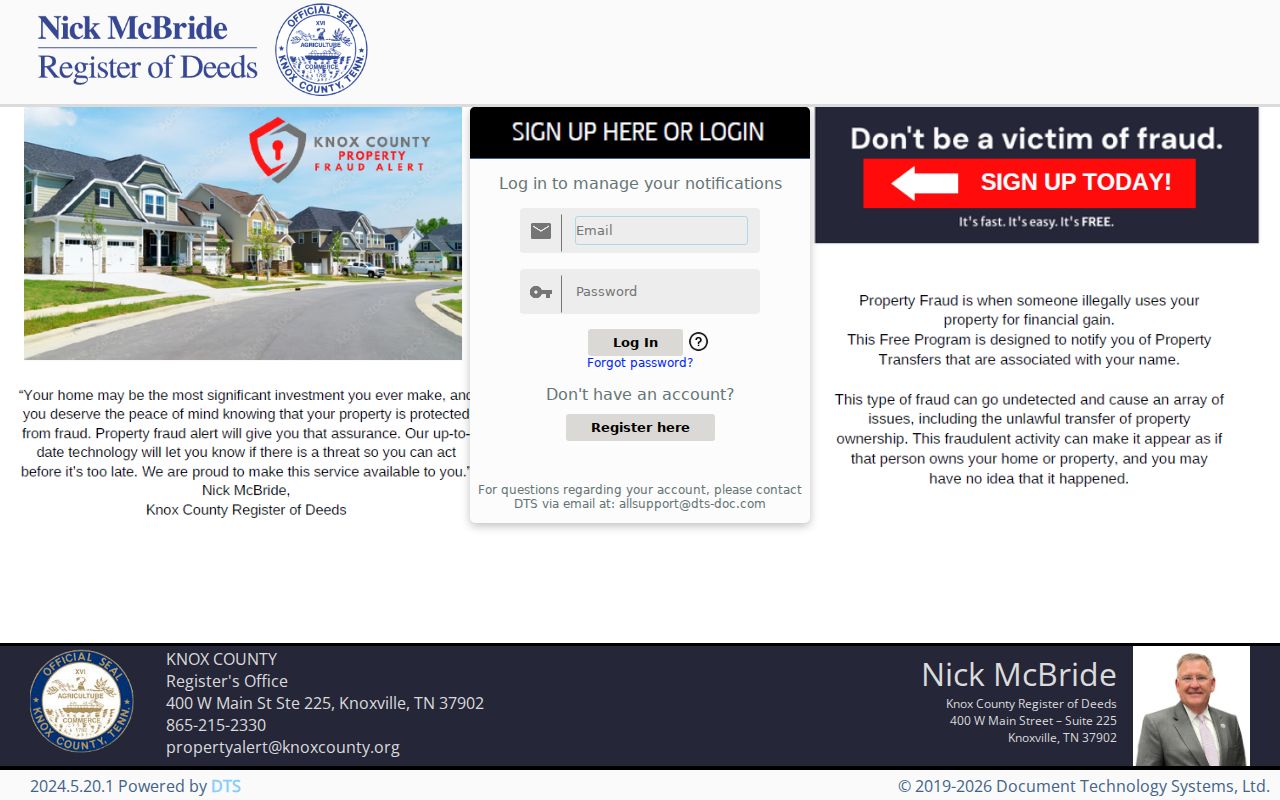
The alert is especially timely. In June 2026, the Register warned that an official-looking property postcard was bogus and directed residents to this free service. If a notice is unexpected, inspect the instrument and contact the Register. Do not assume that a paid mailing is an official copy order when the office supplies certified copies for $1 per page.
Knox County Records Terms
Portal labels can hide important differences. These terms help separate a quick finding from proof supplied by the responsible office.
- Index
- A searchable entry pointing to a record. It may omit facts found in the document image.
- Certified copy
- A custodian-authenticated copy used as official evidence, such as a certified deed page or court decree.
- Custodian
- The office responsible for keeping and responding for a specific record series.
- Exemption
- A law, court rule, or order that closes a record or requires protected portions to be removed.
- Docket
- The court’s case or calendar record. A daily docket lists scheduled matters but may not show the final result.
Read an index first, then ask the custodian for the record form that meets the intended lawful need.
Request Knox County Public Records
A useful request names an existing record, its likely custodian, and a narrow date range. Include a case, parcel, report, book, or instrument number when known. State whether inspection is enough or copies are needed. The state model TPRA form separates those choices and provides space for the subject, dates, contact details, delivery preference, signature, and governmental office.
- Find the creator. Send a deed matter to the Register, a court file to its clerk, and a Knoxville city record to the department that made it.
- Check the official index. Capture the number, date, party role, and document type needed to identify the source file.
- Describe the existing record. Give names, address, date span, and known identifiers. Do not ask the office to create a new list or answer a research question.
- Choose inspection or copies. Inspection is generally free. Ask for an estimate before approving duplication, media, or labor charges.
- Complete identification steps. Provide proof of Tennessee citizenship if the office policy lawfully requests it, plus a clear reply channel.
- Track the response. By the seventh business day, expect access, a written legal denial, or a written time estimate if production was not prompt.
If volume is the issue, narrow the dates or record types. If a denial or fee seems inconsistent with the Act, the Office of Open Records Counsel provides guidance and informal mediation. Tenn. Code Ann. § 10-7-505 permits a petition in circuit or chancery court. Keep the request, response, cost estimate, and cited exemption together before seeking review.